


Why Is My Pool Cloudy?

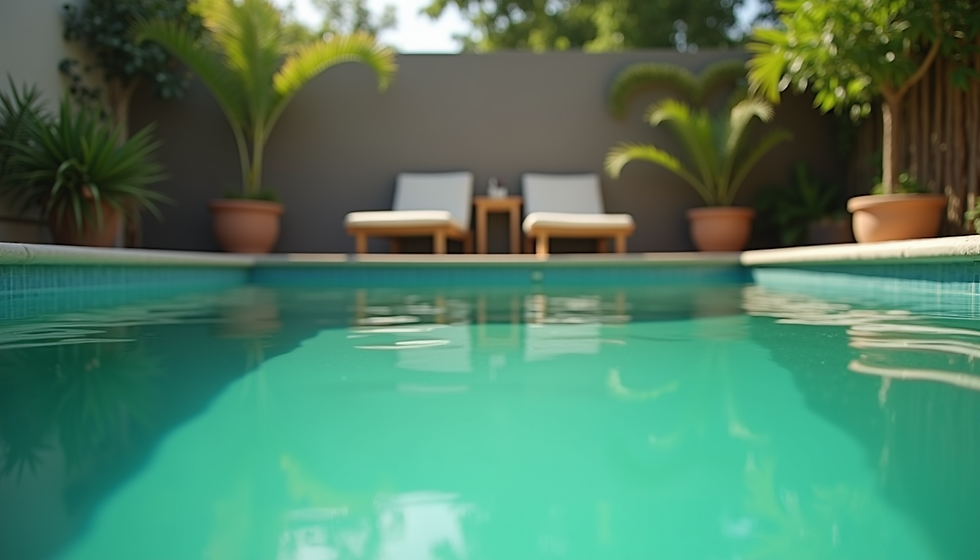
Does your pool water look like the pool in this photo—blue, but cloudy or milky rather than sparkling and clear?
Common Causes and How to Clear It.
Cloudy pool water is one of the most common problems we see in Gold Coast swimming pools. Sometimes it develops gradually. Other times, a pool can become cloudy almost overnight following heavy rain, a busy weekend of swimming or the addition of pool chemicals.
Cloudiness is caused by tiny particles suspended in the water. These particles may be too small for you to see individually, but together they prevent light from passing cleanly through the water.
The important part is identifying why those particles are there. Adding more chemicals without first checking the water can make the problem worse.
Is it safe to swim in a cloudy pool?
If you cannot clearly see the floor, steps or main drain, you should not swim in the pool.
Apart from possible problems with water quality, cloudy water presents a serious safety risk because it can make it difficult to see a swimmer who is in trouble beneath the surface.
What causes cloudy pool water?
1. Low chlorine or ineffective sanitisation
Chlorine helps control bacteria, algae and other organic contaminants. When the free chlorine level becomes too low, contaminants can multiply and the water may begin to look dull, hazy or cloudy.
This frequently happens after:
Heavy rain
Hot weather
A large number of swimmers
Leaves or other organic material entering the pool
The chlorinator being turned down too low
Insufficient pump and chlorinator operating time
Stabiliser levels being too low or too high
The chlorine level should be tested rather than judged by the appearance or smell of the water.
A strong chlorine smell does not necessarily mean there is too much effective chlorine. It can sometimes indicate the presence of combined chlorine created as chlorine reacts with contaminants.
2. Incorrect pH or water balance
Cloudy water is not always caused by insufficient chlorine. Incorrect pH, total alkalinity or calcium hardness can also contribute.
When the pH is too high, chlorine becomes less effective and calcium may begin to come out of solution, giving the water a white or milky appearance.
High calcium hardness, high pH and high total alkalinity can combine to produce calcium clouding or scaling. This is particularly worth investigating when the pool looks milky shortly after chemicals have been added.
Low or poorly balanced water chemistry can also affect swimmer comfort and damage pool surfaces and equipment over time.
3. Chemicals added in the wrong quantity or sequence
Adding too much of a chemical—or adding several chemicals too close together—can temporarily cloud the water.
For example, calcium products, buffer, soda ash, phosphate remover and some chlorine products can create cloudiness while reacting or being dispersed through the pool.
Always follow the product directions, allow appropriate circulation time and avoid mixing pool chemicals. Chemicals should never be combined together in a bucket or container unless the manufacturer specifically directs you to do so.
If you are unsure what the pool needs, have the water tested before adding anything further.
4. A dirty or ineffective pool filter
Your filter removes the fine debris and particles suspended in the water. Even perfectly balanced pool water can remain cloudy if the filter is dirty, blocked, damaged or not operating effectively.
Possible filter problems include:
A sand filter that needs backwashing
Old, channelled or contaminated filter media
A cartridge filter that needs cleaning or replacement
A damaged cartridge
An incorrect multiport valve setting
Internal damage allowing water to bypass the filter
A filter that is too small for the pool or water flow
If you have a sand or glass-media filter, follow the correct procedure when backwashing your pool for clean and clear water.
Backwashing too often can be counterproductive, so use the filter pressure and the manufacturer’s recommendations as your guide.
5. The pool pump is not moving enough water
The pump must circulate the water through the chlorinator and filter. If water flow is reduced, contaminants and fine particles may remain suspended in the pool.
Check for:
A full skimmer basket
A blocked pump basket
A low pool-water level
Air bubbles entering through the suction line
A pump that has lost prime
A blocked impeller
Closed or incorrectly positioned valves
Leaking seals or O-rings
Weak flow from the pool return jets
Unusual pump noises
Our pool pump troubleshooting guide explains the common signs of pump and circulation problems in more detail.
Do not continue operating a pump that is running dry, leaking badly or making unusual grinding or screeching sounds.
6. The pump is not running long enough
Even if the pump and filter are working correctly, they need sufficient operating time to circulate and filter the pool water.
The correct running time depends on the:
Pool volume
Pump flow rate and speed
Filter type and condition
Weather and water temperature
Number of swimmers
Amount of leaves and debris
Chlorinator output
Current condition of the water
There is no single running time that is suitable for every pool. If the pool is cloudy, the filtration system will often need to operate for longer while the underlying cause is being corrected.
Read our guide explaining how long you may need to run your pool pump.
7. Early algae growth
A pool does not have to be bright green to contain algae. Early algae growth may initially make the water look dull, hazy or slightly cloudy.
You might also notice:
Slippery walls or steps
Dust-like material returning after vacuuming
Green, yellow or black patches
Chlorine disappearing unusually quickly
Cloudiness becoming worse during hot weather
The pool should be tested and treated promptly before the algae becomes established.
8. Heavy rain, storms and debris
Gold Coast storms can quickly affect pool-water balance. Rain dilutes chlorine and salt levels, while wind can carry soil, dust, leaves and organic matter into the water.
Stormwater or garden runoff entering the pool can introduce even more contamination. The water may remain cloudy until the chemistry is corrected and the suspended material is removed through filtration, vacuuming or, in severe cases, flocculation.
9. High phosphate levels
Phosphates can enter a pool through leaves, soil, fertilisers, rainwater, organic debris and some pool chemicals. They provide a food source that can assist algae growth when chlorine levels fall.
Phosphate remover can also temporarily make the water cloudy because it converts dissolved phosphate into particles that the filter can capture.
Phosphate control is not a replacement for maintaining adequate chlorine, but it can form part of an overall algae-prevention strategy. Learn more about how to remove phosphates from pool water.
10. Fine debris that the filter cannot easily capture
Dust, dead algae and other microscopic particles may be too fine for the filter to remove quickly. In appropriate circumstances, a clarifier can help bind small particles together so the filter can capture them.
A flocculant works differently. It causes suspended material to settle on the pool floor so it can be vacuumed to waste.
Flocculants should not be used as an automatic first response to every cloudy pool. The filtration system, pool surface and waste setup must be suitable, and incorrect use can create additional problems.
What should you do when your pool becomes cloudy?
Start with the cause rather than adding random chemicals:
Do not swim if you cannot clearly see the bottom of the pool.
Remove leaves and debris from the pool.
Empty the skimmer and pump baskets.
Check the pool-water level.
Check that water is flowing strongly through the return jets.
Test the free chlorine, pH, total alkalinity and other relevant water levels.
Inspect and clean or backwash the filter when required.
Brush the walls, steps and floor.
Vacuum any settled debris.
Run the filtration system for sufficient time and retest the water.
Avoid repeatedly adding shock, clarifier, flocculant or phosphate remover without understanding the reason for the cloudiness. More chemical is not always the solution.
How long will a cloudy pool take to clear?
The clearing time depends on the cause and severity of the problem.
Minor cloudiness caused by recent chemical treatment may clear after several hours of effective
circulation. A dirty filter, algae outbreak, severe water imbalance or a large amount of fine debris may take several days and require professional treatment.
If the pool remains cloudy despite balanced water and continuous effective filtration, there may be a problem with the filter, pump, plumbing or circulation system.
Need help clearing your cloudy pool?
Poolzone provides pool servicing, water testing, equipment inspections and pool pump and filtration repairs across the Gold Coast.
We can identify why your pool is cloudy and recommend the appropriate treatment, rather than continuing to add chemicals without resolving the underlying problem.
Contact Poolzone on 0432 105 352 to arrange a pool inspection or service.


Comments